

A Legacy of Storytelling
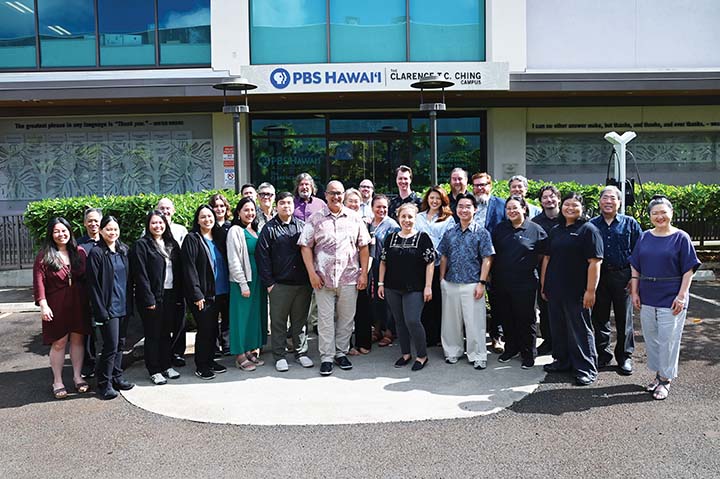
Photo by Duane Ikeda
As PBS Hawaiʻi marks its 60th birthday, it’s a moment to honor the past and imagine what comes next. The station first went on air on April 15, 1966, broadcasting from the cafeteria at University Lab School under the name Hawai‘i Educational Television Network. Over the years, the name and location have changed, but one thing has stayed the same: Viewers across the state continue to trust PBS Hawaiʻi to deliver thoughtful programming that only public media can provide.
For president and CEO Ron Mizutani, the milestone is deeply personal, marking not only the station’s legacy, but also his own journey alongside it.
“Turning 60 alongside PBS Hawaiʻi hits me in a really personal way,” says the former KHON news anchor. “It takes me back to that kid in Kalihi, sitting on the living room floor watching The Adventures of Letterman on The Electric Company, and singing along with Fred Rogers at the start of every Mister Rogers’ Neighborhood, not knowing how much those shows and this community would shape my life.”
That sense of continuity, of generations shaped by shared experiences, has long defined the station’s role in Hawaiʻi. Before the era of streaming and smartphones, PBS Hawaiʻi was a gathering place for families to learn and grow.
“Long before smart TVs, cell phones and social media, PBS Hawaiʻi was what brought generations together,” Mizutani notes.
Kids learned new things on Sesame Street, families tried recipes from Titus Chan on The Chan-ese Way, and everyone could relive local sports moments with Jim and Kanoa Leahey on Leahey & Leahey. These programs created bonding moments that brought parents, grandparents and keiki together, giving them something to watch (and talk about) side by side.
For many families, programs like PBS NewsHour, Nature and Masterpiece became a nightly ritual, offering trusted spaces to explore the world with the calm, measured perspective Hawaiʻi viewers have come to rely on.
From beloved children’s programming to trusted news and cultural content, the station has offered something increasingly rare in today’s media landscape: space for thoughtful engagement. Families didn’t just watch. They discussed, reflected and connected, often across generations.
That spirit continues today, even as platforms have evolved. Digital channels and social media now extend the station’s reach, but its core mission remains to inform, connect and preserve the stories of Hawaiʻi.
Central to that assignment is a slate of local programming that reflects the islands’ unique identity. Shows like Nā Mele, INSIGHTS and HIKI NŌ on PBS Hawaiʻi have become pillars of the station’s voice, each offering a different lens into the community.
“Nā Mele has become part of Hawaiʻi’s soundtrack,” Mizutani says. “For 25 years, it has celebrated the music and artists who carry our stories, our memories and our sense of place.”
An unwavering commitment to local storytelling sets PBS Hawaiʻi apart from other media outlets. Whether it’s music, dialogue or student-produced journalism, the focus remains on amplifying voices that might otherwise go unheard.
That same philosophy extends beyond the screen. As a community-funded organization, PBS Hawaiʻi works closely with nonprofits and grassroots groups, offering them a platform to share their work and deepen public understanding.
“When something matters to Hawaiʻi, we want the people closest to that work to have a place to tell their story,” Mizutani says.
It’s an approach rooted in partnership rather than performance, and one that prioritizes impact over ratings. From in-depth features to shorter segments, the goal is consistent: to bring visibility to the issues shaping local communities.
In a rapidly shifting media environment, that authenticity has become one of the station’s greatest strengths. While misinformation and content saturation dominate many platforms, PBS Hawaiʻi continues to stand apart as a trusted source. This allows the station to engage in meaningful conversations, even on complex or sensitive topics.
“Public television still matters because people trust it, and that trust has been built over generations,” Mizutani adds.
One such moment came in 2021, when PBS Hawaiʻi partnered with Mental Health America of Hawaiʻi to address the growing mental health challenges facing young people.
Through open dialogue and student storytelling, the initiative helped reduce stigma and foster connection, thus demonstrating the power of media to both inform and heal.
That commitment to the next generation is especially evident in HIKI NŌ, the station’s student journalism program. More than a training ground, it serves as a launching point for future storytellers and leaders. By equipping students with both technical skills and a strong ethical foundation, the program ensures that Hawaiʻi’s narratives remain in the hands of those who understand them best.
“And if we want Hawaiʻi’s stories to live on, we need the next generation not just to carry them, but to tell them,” Mizutani says.
As the media landscape continues to evolve, PBS Hawaiʻi faces both challenges and opportunities. Changing viewing habits, funding uncertainties and the rise of digital platforms all require thoughtful adaptation.
“When I think about the future of PBS Hawaiʻi, I picture a place that still feels like home, even as everything around us keeps changing,” Mizutani says.
Looking ahead, he envisions a station that meets audiences where they are, a station that expands its digital presence while staying grounded in community values. It’s a future that embraces innovation without losing sight of what has made PBS Hawaiʻi essential for six decades.
That balance, between past and future, tradition and transformation, is what will carry the station forward. Because in Hawaiʻi, storytelling is more than entertainment. It is a way of preserving culture, strengthening connections and honoring the shared experiences that define the islands.
For 60 years, PBS Hawaiʻi has done just that. And as it looks toward the future, its role remains as vital as ever: a trusted home for Hawaiʻi’s stories, told with care, integrity and heart.
The 60th anniversary will be a year-long celebration, with programs across PBS Hawaiʻi’s on-air and digital platforms. From 7:30 to 9 p.m. on April 30, viewers are invited to join the 60th anniversary pledge show, a walk down memory lane hosted by iconic musician, teacher and longtime PBS supporter Keola Beamer. It promises to be a night full of reminiscing, music and celebrating the vital role PBS Hawaiʻi has played in the islands for six decades.
Learn more at pbshawaii.org.